A scalable multimodal framework for unbiased risk biomarker discovery across multiple cancer types
Constantin Petrescu, Lisa Schmunk, Jack Monahan, Abbas Salami, Tom Stubbs, PhD
Abstract
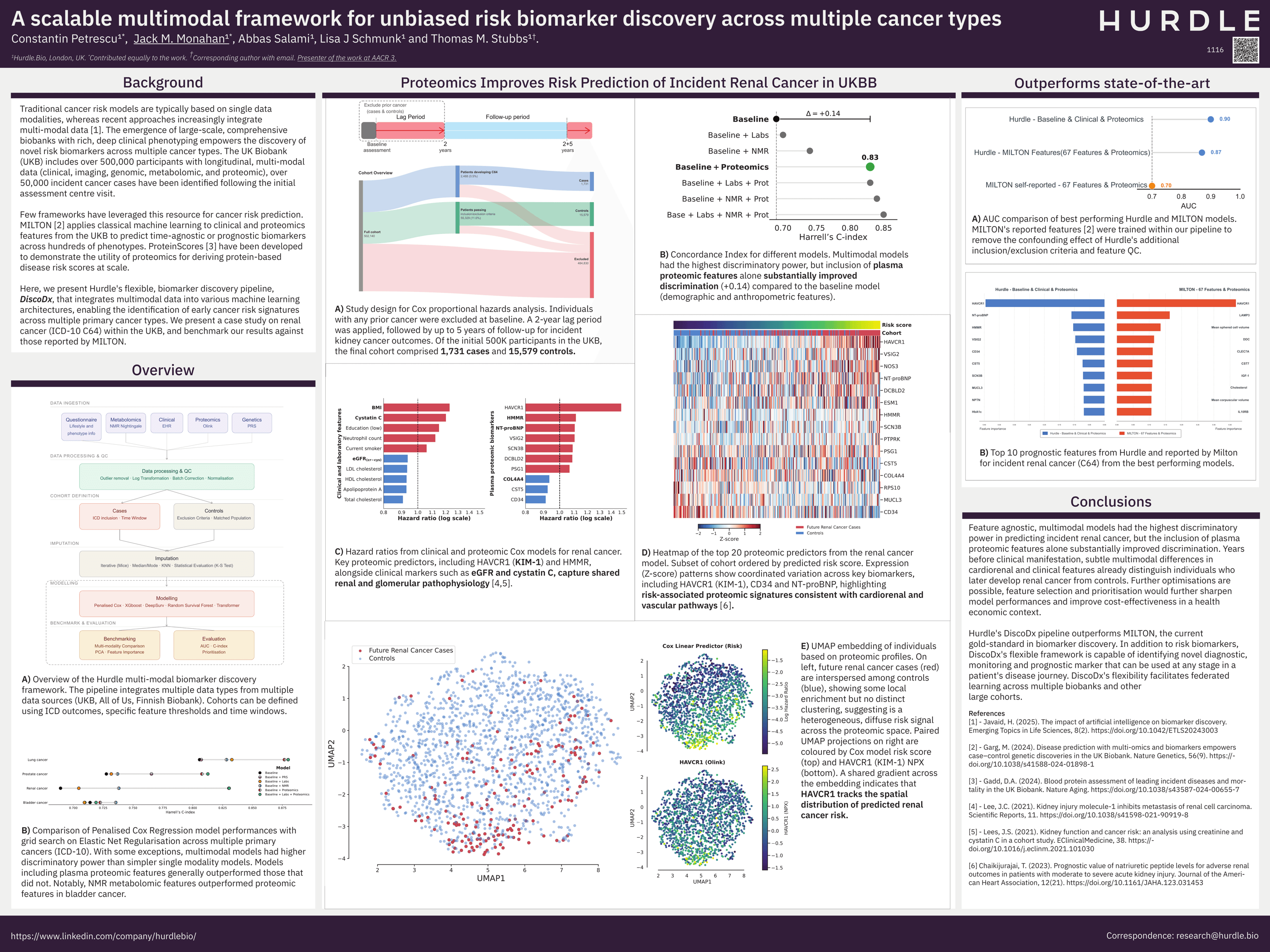
Background: Most existing cancer risk models are built on single modalities and hand-selected features. Systematic, unbiased integration of germline genetics, plasma proteomics, and deep clinical phenotyping holds promise for revealing novel risk biomarkers across diverse cancer types.
Methods: We developed a multi-modal biomarker discovery engine that can be used for discovering risk, diagnostic, prognostic, predictive and monitoring biomarkers. Currently the framework handles:
- Germline genetics and polygenic risk scores
- High-dimensional plasma proteomics (Olink)
- Longitudinal primary-care records, hospital episodes, laboratory results, lifestyle questionnaires, and cancer registry linkages
Key design features include modular cohort handling, automated data preprocessing, and machine-learning models (including: gradient boosting and neural networks).
Application: The platform is currently deployed on the UK Biobank (n = 502,505 participants; >46,000 incident cancers across 22 cancer types) with active model training and biomarker discovery in progress. The architecture is cohort-agnostic and ready for direct application to emerging large-scale resources including Our Future Health and the All of Us Research Program.
Poster presentation: We will demonstrate the platform’s configurability through examples of cancer-risk modelling in the UK Biobank, showcasing: (i) comparative performance of individual modalities versus multimodal ensembles, (ii) cancer-specific patterns of modality contribution, and (iii) the effect of time-window filtering on separating true predictive signals from prevalent disease effects.
Conclusions: By eliminating bias in feature engineering and supporting seamless integration of diverse health data streams, this scalable framework provides a robust foundation for data-driven discovery of multimodal cancer risk biomarkers, paving the way for next-generation precision prevention strategies.