
Testing and Validating Your Diagnostics Pathway
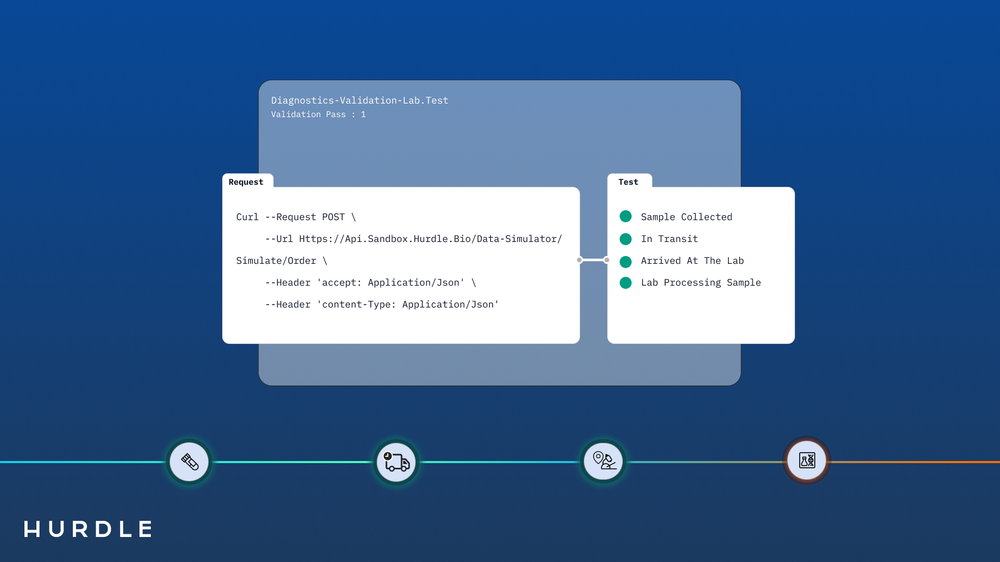
Designing and delivering a complete diagnostics pathway is one of the most complex challenges in healthcare technology. It’s not just about the science or clinical governance. It’s about ensuring a patient’s journey—from ordering a test, through sample collection, logistics, lab analysis, and results delivery—works seamlessly every single time.
But building and validating that end-to-end flow is both time-consuming and costly. Unlike pure software systems, diagnostics involve physical products, people, and physical processes such as lab testing.
The Challenge of Testing Physical Flows
If you’re designing a mobile app, you can quickly test features with automated tools and simulated users. But how do you “simulate” a blood test kit being shipped in the post? Or a sample being processed at the lab? Or a phlebotomy appointment being cancelled?
Traditionally, the only way to test these scenarios has been through building out an extensive test harness yourself, or physically processing real samples. These are slow to run, expensive to manage, and only cover a fraction of the possible pathways your system will encounter once launched. That creates a real barrier to innovation in diagnostics.
Introducing Hurdle’s Data Simulator
At Hurdle, we’ve built a data simulator to solve these challenges. It allows you to emulate entire diagnostics pathways—or individual events within them—without waiting for reality to unfold. This means you can validate and test your systems thoroughly at far less cost.
Some of the key features include:
- Cross-modality support: Whether your pathway involves at-home test kits, mobile phlebotomy services, or in-clinic testing, you can simulate the flow from order to result.
- Event-level emulation: For phlebotomy flows, you can replicate specific events such as nurse assigned, appointment scheduled, or appointment cancelled. This enables you to design for contingencies before they happen in real life.
- Flexible access: Use ourAPI to integrate simulation directly into your development workflow, or get started quickly via our dashboard interface.
Why It Matters
By simulating diagnostics pathways, organisations can:
- Accelerate development: Quickly test new pathways and services without waiting for physical pilots.
- Reduce costs: Avoid running multiple large-scale pilots just to uncover basic failure modes.
- Improve reliability: Identify and fix weaknesses before they impact patients.
- Enhance innovation: Experiment with new models of care—like hybrid at-home and clinic-based flows—without the traditional risks.
Building Confidence in Diagnostics
Ultimately, diagnostics only work if patients and clinicians can trust them. That trust comes not just from the accuracy of a test, but from the reliability of the whole pathway around it. By providing a way to rigorously test and validate these pathways in advance, Hurdle’s data simulator helps ensure every patient’s journey is smooth, consistent, and dependable.

CTO & Co-founder, Hurdle
Rob is CTO and one of the co-founders at Hurdle where he overseas Product, Engineering and Design. He believes technology has the power to bring the amazing discoveries in biology to the masses at a pace never seen before.
LinkedIn →Working on something similar? We can talk through how Hurdle would approach it.
Talk to us →