
AI, System Connectivity, and Next-Gen Diagnostics: What We Saw at ADLM 2025
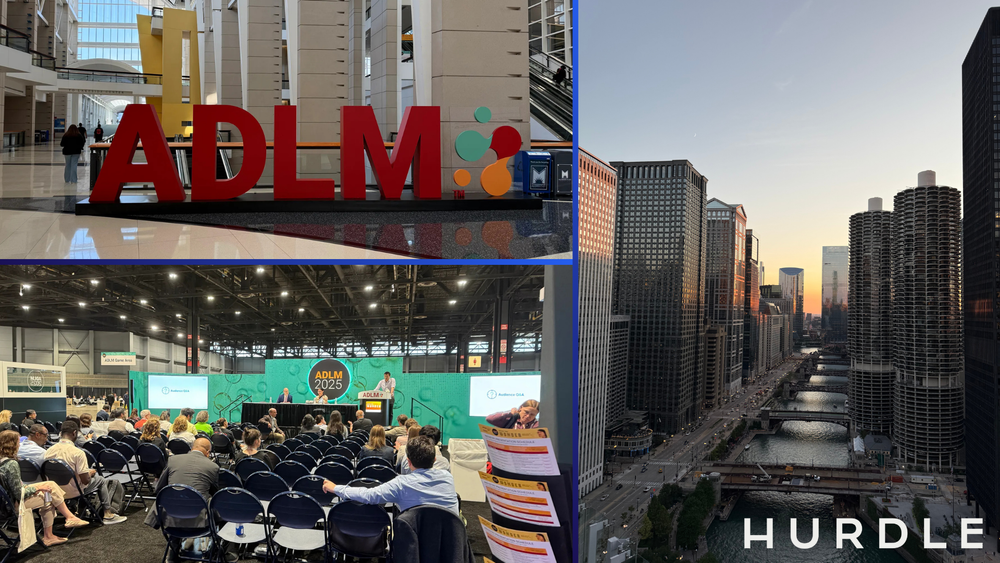
Why We Went to ADLM 2025
ADLM 2025 brought together global leaders in clinical diagnostics, lab informatics, and digital health. We were there to connect with innovators at the intersection of data, devices, and diagnostics and to share how Hurdle is enabling next-generation workflows through data integration and AI, APIs, and logistics designed for precision medicine. Our goals: scout emerging technologies and deepen partnerships across diagnostics, genomics, and digital health.
Important Talking Points at the Conference
- AI and microbiome science are converging with diagnostics, moving from concept to real-world application.
- Regulators are sharpening their focus on validation and post-market surveillance for lab AI and advanced biomarkers.
- Many labs use different LIMS (Laboratory Information Management Systems) that don’t work well together, but labs and vendors are working on ways to connect them so information flows more easily.
- Genomics is becoming a routine part of clinical practice, driving a need for better tools, training, and infrastructure to manage and apply genetic insights.
- From Alzheimer’s biomarkers to point-of-care infectious disease testing, the pipeline for faster, more precise diagnostics is accelerating.
Key Takeaways
1. Generative AI Moves into the Lab Carefully
- What we saw: Li Zha’s session on generative AI highlighted real-world examples like hospital chatbots, EHR integration, and diagnostic image analysis. The tone was pragmatic excitement balanced with caution about HIPAA compliance, bias, and over-reliance on early-stage tools.
- What it means: AI is here to stay in labs, but adoption will hinge on workflow fit, validation, and system connectivity with LIS/LIMS platforms.
- Our POV: We see AI not as a bolt-on, but as an embedded capability, from sample tracking to decision support, backed by clinical-grade validation.
2. Precision Biomarkers Are Going Mainstream
- What we saw: Advances in Alzheimer’s diagnostics (p-Tau217 assays), microbiome-based risk prediction, and multi-omic biomarkers were front and centre. Sessions stressed clinical readiness, reimbursement pathways, and regulatory acceptance.
- What it means: The biomarker landscape is shifting from discovery to scalable deployment. Those that can be validated and integrated into routine workflows will define the next decade.
- Our POV: Hurdle’s role is to help bring biomarkers to market as LDT and support the launching of them.
3. Point-of-Care Testing Tackles Access Gaps
- What we saw: Multiple sessions, from STIs to infectious diseases, addressed how POCT can cut diagnosis time from days to minutes, but reimbursement, clinician adoption, and distribution remain major barriers.
- What it means: POCT is a critical lever for healthcare equity, especially in underserved communities, but tech readiness must be matched by market readiness.
- Our POV: We’re focused on building seamless connections between POCT devices and clinical data systems so results flow directly into patient care pathways.
4. Genomics Becomes a Routine Part of Clinical Practice
- What we saw: Heidi Rehm emphasised that genomics is moving from a niche specialty to a core part of everyday medicine, with widespread implications for rare disease diagnosis, cancer risk assessment, and precision treatment planning.
- What it means: This shift demands better tools, training, and infrastructure for providers, as well as policies that enable equitable access and reimbursement.
- Our POV: Hurdle is committed to enabling labs and health systems to integrate genomic insights alongside other clinical data, so results are actionable, traceable, and ready for clinical decision-making.
What’s Next
The take-home from ADLM 2025 is clear: diagnostics is entering an era of convergence AI, advanced biomarkers, and genomics will define competitiveness. Hurdle is positioned to be the connective tissue between innovation and implementation.
Working on something similar? We can talk through how Hurdle would approach it.
Talk to us →