
A Single-Platform Companion Diagnostic for Heart Failure
Proteomics alone delivers almost all of Aurora's prognostic power, simplifying the path to a deployable CV-death test. UK Biobank (N ≈ 500,000).
Why single-platform matters
A test that needs proteomics plus genetics plus assembled clinical history is hard to validate, hard to reimburse, and hard to run in routine care. Each added modality multiplies sample handling, data integration, and regulatory surface area. If one platform carries the signal, the route from signature to a deployable, qualifiable companion diagnostic is materially shorter.
Proteins carry the prognostic signal
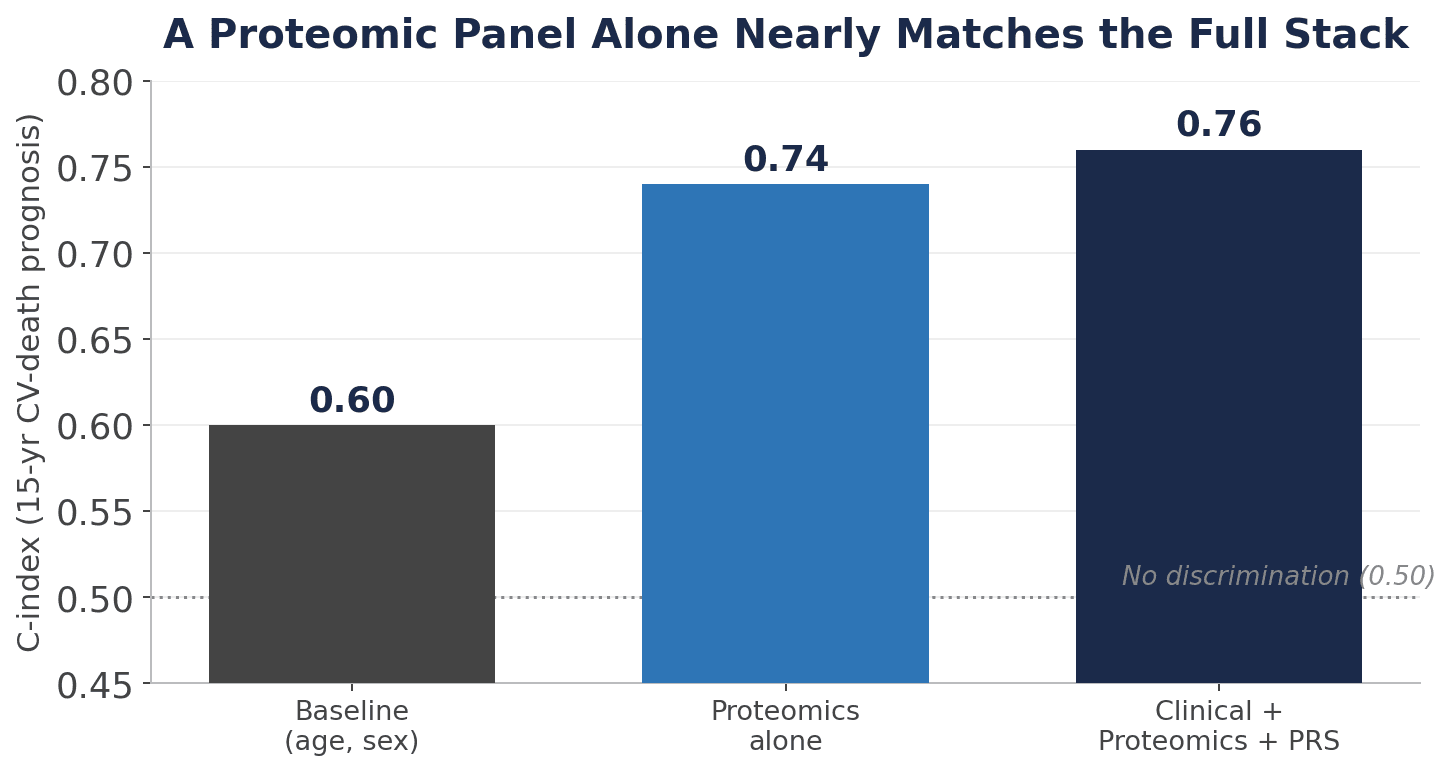
C-index for 15-year CV-death prognosis, by data modality. UK Biobank HF cohort.
Proteomics alone lifts discrimination from a C-index of 0.60 (baseline demographics) to 0.74, almost matching the best multimodal model at 0.76. Genetics alone adds little, and layering clinical labs and PRS on top of proteomics buys only a final fraction. For a prognostic test, the proteomic panel is close to sufficient.
| Modality | C-index | ROC-AUC |
|---|---|---|
| Baseline (age, sex) | 0.60 | 0.588 |
| Baseline + proteomics | 0.74 | 0.716 |
| Baseline + clinical + proteomics + PRS | 0.758 | 0.743 |
Table 1 — discrimination by data modality: proteomics alone nearly matches the full multimodal stack.
A multi-protein signature also doubles the hazard ratio for CV death versus NT-proBNP alone (3.50 vs 1.77 per SD), so the single-platform test is both simpler and sharper than the canonical single marker.
One panel spans the disease biology
The reason a single platform suffices is that the panel samples several independent processes at once, which a single analyte cannot:
| Process | Representative panel proteins |
|---|---|
| Congestion / wall stress | NT-proBNP, ANGPT2 |
| RAAS / renal perfusion | Renin, EDN1 |
| Fibrosis / tissue remodelling | SPON1, HGF, SCGB3A1 |
| Metabolic / systemic stress | ANGPTL4, GDF-15, REG4 |
Table 2 — one panel samples several independent disease processes at once.
Why it matters for a diagnostic programme
A proteomics-only readout shortens validation, simplifies the regulatory and reimbursement story, and fits existing panel-based workflows. Aurora discovers and validates the signature on population-scale data, then ports it to other endpoints by changing the cohort definition, with auditable cohorts throughout. The result is a faster, more defensible route from biomarker hypothesis to a deployable companion diagnostic.

CEO, Hurdle
He/Him. Tom is CEO at Hurdle, a diagnostic-as-a-service company. Tom is a specialist in Epigenetics, Machine Learning, and Computational Biology.
LinkedIn →Contact us to discuss proteomic companion-diagnostic development for your programme.
Talk to us →